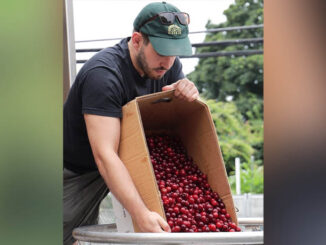
A cidery’s busiest hours can also expose one of its biggest business challenges: what happens to the building when customers aren’t there? For Seek No Further Cider, the answer has been to add some java.
After moving its production offsite, the Granville, Ohio cidery found itself with space that could be used differently. The addition of a café gives the business another reason to bring customers through the doors during mornings and early afternoons, when hard cider naturally has less pull. But the bigger lesson for other cidery owners may have little to do with coffee.
“The biggest issue was that we had a space productive in the afternoons, evenings and weekends, but it was largely sitting idle during the morning and early afternoon,” co-founder Garrett Huber told BREWER & Cider Business. “We already had the real estate, the seating, the parking and the customer-facing infrastructure, so we started looking at how to make better use of it during those slower periods.”
That distinction is important. Seek No Further wasn’t looking for additional square footage. It was looking for additional productivity from the square footage it already had.
“Daytime was a pretty significant opportunity for us,” Huber said. “A cidery is naturally an afternoon and evening business, but there are many hours in the day when the building isn’t generating much revenue. We didn’t necessarily need more space — we needed to get more productive hours out of the space we already had.”
That can be a useful starting point for others evaluating their own operations. Instead of immediately asking how to increase cider sales, owners can first examine when the building is generating revenue, when it’s sitting idle and whether the existing infrastructure can support another use. For Seek No Further, coffee provided a relatively natural answer.
“Coffee made sense because it was a natural fit for the space and for the community we are in,” Huber said. “We already had a comfortable gathering space, and coffee gives people a reason to come in during a completely different part of the day.”
The strategy isn’t simply to get existing cider customers to visit more often. The café is intended to introduce the Seek No Further brand to people who may have little reason to visit a cidery during its traditional operating hours.
Huber specifically sees potential in parents, remote workers, people meeting for coffee and others looking for a place to spend part of their morning.
“The goal is really to diversify how the business operates throughout the day rather than just trying to sell more cider to the same people,” he said.
That approach also changes how an owner can think about the value of a taproom. A space doesn’t necessarily have to be limited to its primary product or traditional daypart if the infrastructure and community support another use. Still, Seek No Further has resisted the temptation to build the entire concept before knowing whether customers will come.
“We tried to approach it in stages rather than immediately making a huge investment,” Huber said. “We wanted to prove there was demand and we are still attempting to prove that.”
The initial investment focused on necessities such as water filtration, electrical work, coffee equipment and creating an environment appropriate for daytime customers. Additional investment can then follow evidence of demand.
“One thing we’ve tried to be careful about is not overbuilding something before we know what the demand looks like,” Huber said. “It’s easy to spend a lot of money making a coffee program look great. It’s much more important to figure out whether the customers are actually going to show up consistently.”
That test-and-learn philosophy can apply well beyond coffee. A cidery considering breakfast, lunch, coworking, classes, markets, fitness programming or other community uses can first determine whether the concept attracts customers before committing substantial capital.
The experiment also doesn’t mean treating the secondary business as an afterthought. Seek No Further brought in experienced baristas rather than simply adding coffee preparation to the responsibilities of its existing hospitality staff.
“Coffee looks deceptively simple from the outside,” Huber said. “We already had people who were very good at hospitality and bartending, but making great espresso drinks and running a good coffee program are different skill sets.”
The decision reflects another broader business lesson: expanding into an adjacent category still requires taking that category seriously.
“We wanted the coffee to be taken seriously rather than treating it as an add-on to the bar,” Huber said.
Ultimately, Huber believes the most valuable change is conceptual. Cideries can view their buildings as hospitality assets rather than simply places that sell cider.
“A lot of cideries are naturally busy at night and on weekends, but that can leave a lot of valuable real estate sitting empty for large portions of the week,” he said. “Before assuming the answer is to sell more cider, I’d look at whether there are other reasons people could use the space.”
For some, that might mean coffee. For others, the answer could be something entirely different.
“The important thing is finding something that fits your community and your existing infrastructure,” Huber said.
That may be the most transferable part of Seek No Further’s approach. The objective isn’t necessarily to copy its café model. It’s to examine the assets a cidery already owns. It can be space, parking, seating, hospitality capabilities, location and customer relationships, and then determine whether those assets can serve more customers at more times of the day.
READ MORE: Expanding your Audience With Food Pairings
“You don’t necessarily have to have the perfect answer on Day 1,” Huber said. “You can test an idea, learn from the customers who actually show up, and then decide how much you want to invest.”
If you are facing pressure to generate more revenue from existing operations, that can be a different way of approaching growth. Rather than continually pushing the core product into the same customer base, the opportunity may be to give the building itself more jobs to do.
“I think there’s a broader opportunity for cideries to think of themselves less as places that are open when people want to drink cider and more as hospitality spaces that happen to make and sell cider,” Huber said. “If we can make the building useful at 7 a.m., 12 p.m. and 7 p.m., that’s a much more productive business than one optimized only for the evening.”