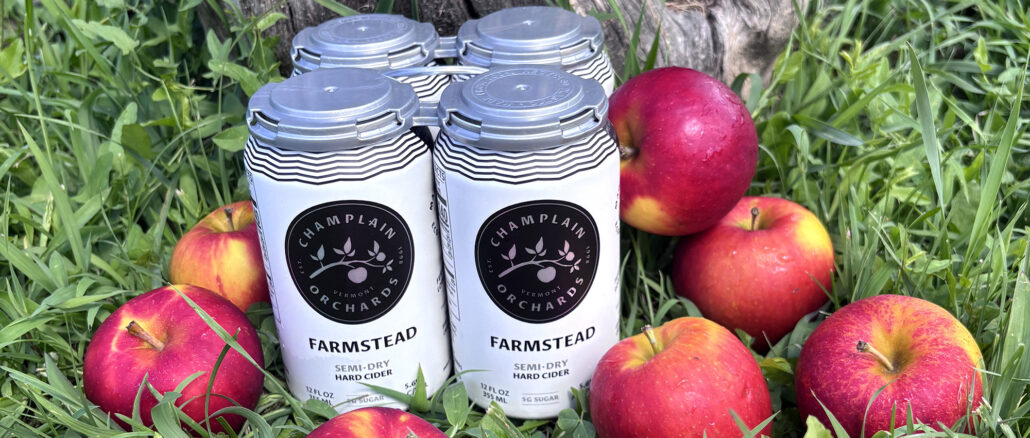
By focusing on consistency, versatility and an approachable flavor profile, the Vermont cidery has built a dependable seller that also serves as an entry point for new customers.
When looking to build a sustainable product portfolio, the newest release or most distinctive flavor isn’t always the biggest contributor to the business. Sometimes, the product that delivers the most value is the one that’s been there from the beginning.
At Champlain Orchards, the Farmstead brand has filled that role for years. The Shoreham, Vermont orchard’s original cider, first produced under the name Original, remains a cornerstone of its lineup, earning recognition that includes No. 3 on USA Today’s 10Best Ciders list in 2026.
For Head Cider Maker Joelle Burbank, the recognition is a welcome acknowledgment of a product that’s never needed to be the flashiest offering to earn its place in the portfolio.
“From the beginning, Farmstead has always been a staple of our hard cider portfolio,” Burbank told BREWER & Cider Business. “It’s always been a quiet workhorse, which is why it’s nice to see it getting recognition now from USA Today.”
It shows that a dependable core product can be a strategic asset, even when it doesn’t generate the same excitement as seasonal releases, experimental batches or limited-edition offerings.
Farmstead’s staying power starts with its formulation. The cider blends apples from Champlain Orchards’ collection of more than 100 varieties and is lightly sweetened with apple juice. The recipe has remained essentially unchanged throughout the company’s history, giving returning customers a consistent experience while maintaining a broad appeal.
“Most cideries have a version of this cider, something that’s slightly sweet and apple-forward,” Burbank said. “While there are many similar ciders on the market, we take pride in making ours the best it can be.”
That consistency doesn’t mean the production process is an afterthought. Champlain Orchards grows all its fruit ecologically on its own orchard and uses a cooler, slower fermentation approach to preserve flavor and aromatics.
Burbank describes the process as “low and slow,” a deliberate choice that supports the character the cidery wants to maintain in a product that depends on familiarity rather than novelty to retain its place in the market.
A core cider’s value isn’t necessarily tied to how frequently its recipe changes. Establishing a recognizable profile and consistently delivering on it can give customers a reason to return, while allowing the business to experiment elsewhere in its portfolio. Farmstead’s positioning also reflects a practical understanding of customer expectations. Although cider styles have diversified, an apple-forward profile remains an accessible starting point for consumers who may be unfamiliar with the category. Its balance between sweetness and dryness also makes it easier to recommend across a range of preferences.
“While not all ciders have an apple-forward flavor profile, that’s often what people expect from a cider, and in that regard, this one delivers,” Burbank said. “It also pairs well with many types of food, so it’s a versatile drink for many occasions.”
That versatility has translated into a particularly strong position in draft sales. Farmstead is Champlain Orchards’ best-selling cider on draft, a distinction she attributes in part to the buying decisions of bars that carry a limited cider selection.
When a bar has room for only one cider tap, a familiar, broadly appealing option can be a safer choice than a product aimed at a narrower audience. For the cidery, that makes Farmstead valuable beyond the individual sale: It helps secure placements where the opportunity to introduce customers to other products might otherwise not exist.
“Farmstead probably gets less marketing attention than others in our lineup because there is a natural demand for it,” Burbank said. “It pleases many palates, being neither too sweet nor too dry.”
It shows you don’t always need marketing to be distributed evenly across a product portfolio. A cider with established demand may need less direct promotion than one that requires customers to understand an unfamiliar style or flavor profile. That can free up attention for newer products while the core offering continues to perform. However, natural demand shouldn’t be confused with a product that no longer needs attention. Farmstead’s continued recognition and the cidery’s emphasis on its production process point to the importance of maintaining quality even when a product has become familiar to both customers and staff.
The cider also plays a role in developing new business. Burbank said Farmstead is often the first cider a new customer tries and the first product a new wholesale account brings in. Its approachable profile gives retailers and hospitality operators a straightforward introduction to the brand without requiring them to commit immediately to a more specialized offering.
“In that regard, it has helped to gain us lots of new business,” she pointed out.
It’s an important distinction when evaluating the performance of an established product. Its contribution may extend beyond the revenue it generates directly, by helping open accounts and establish trust with buyers while introducing customers to the rest of the portfolio.
READ MORE: Building Stronger Cidery Teams Through Strategic Hiring and Training
Farmstead’s place in the business is also evident in its wholesale sales. It’s Champlain Orchards’ second-best-selling product in that channel, recently overtaken by Kingston Dry, a bone-dry cider that reflects growing interest in completely dry, sugar-free options.
Burbank doesn’t suggest that every cidery needs to develop a slightly sweet, apple-forward flagship. Instead, it highlights the business value of understanding which products attract new customers, which satisfy specific market segments and which help wholesale partners make buying decisions. Farmstead has also earned recognition beyond USA Today’s annual list, placing seventh in 2025 and ninth in 2024. It won first place in the Great International Beer, Cider, Mead & Sake Competition in 2022 and has received multiple medals in the Big E Cider Competition, which Champlain Orchards enters each year.
Farmstead may not be Champlain Orchards’ most attention-grabbing cider, but its longevity demonstrates why dependable products deserve a deliberate place in a cidery’s business strategy.